
Why Information Alone Does Not Change Behaviour
The Hidden Footprint of a Click
We spend a lot of time thinking about what our communication says. We obsess over the headline, the curation of the imagery, and the exact emotional journey a user takes when they land on a campaign. But we rarely calculate what that piece of communication costs once it lives online.
Every website, campaign video, high resolution PDF, and forgotten file stored in the cloud relies on heavy physical infrastructure: electricity, intensive cooling systems, servers, data centres, and massive amounts of land and water. When you multiply that by the sheer volume of brand assets created every single year, a simple click carries immense physical weight.
Digital does not mean weightless.
Some argue that optimizing digital assets is too small to matter. The data tells a different story. The global internet and digital technology ecosystem is currently responsible for roughly 3.8% of global greenhouse gas emissions. That places its carbon footprint higher than the entire commercial aviation industry. Because digital waste is invisible, it expands completely unchecked.
Putting the Philosophy to the Test
As Kepler Studio moves deeper into sustainable communication, we wanted to test whether this thinking could hold up under real creative constraints.
So we set a challenge for our own brand: could the Kepler Studio portfolio site become a lower-carbon digital experience without feeling dull, stripped back or bare minimum?
Creative portfolios are notoriously heavy. They rely on high-fidelity case studies, rich media libraries and carefully crafted layouts to show the work properly and build trust. The question was not how to make a stripped-back website, but how to create a beautiful digital experience that uses less.
Strategy Over Decoration
We designed the site in Framer with clear creative boundaries. The aim was not to remove polish, movement or richness, but to be more intentional about what deserved to be there.
Purposeful delight
We avoided unnecessary scroll animations and heavy background scripts. Movement can add emotion, but only when it serves the idea.
Restrained typography
We kept the font system clean, legible and web-friendly to protect the brand feeling without adding unnecessary load.
Asset optimisation
We compressed images and videos before upload, using lighter formats like WebP while protecting visual quality. This became the biggest win: a polished site with far less unnecessary weight.

The Reality of Scale and Transparency
After the initial asset optimisation, the landing page performed well on Website Carbon. But the more we tested, the clearer it became that a carbon score is not a permanent trophy. It is a diagnostic snapshot.
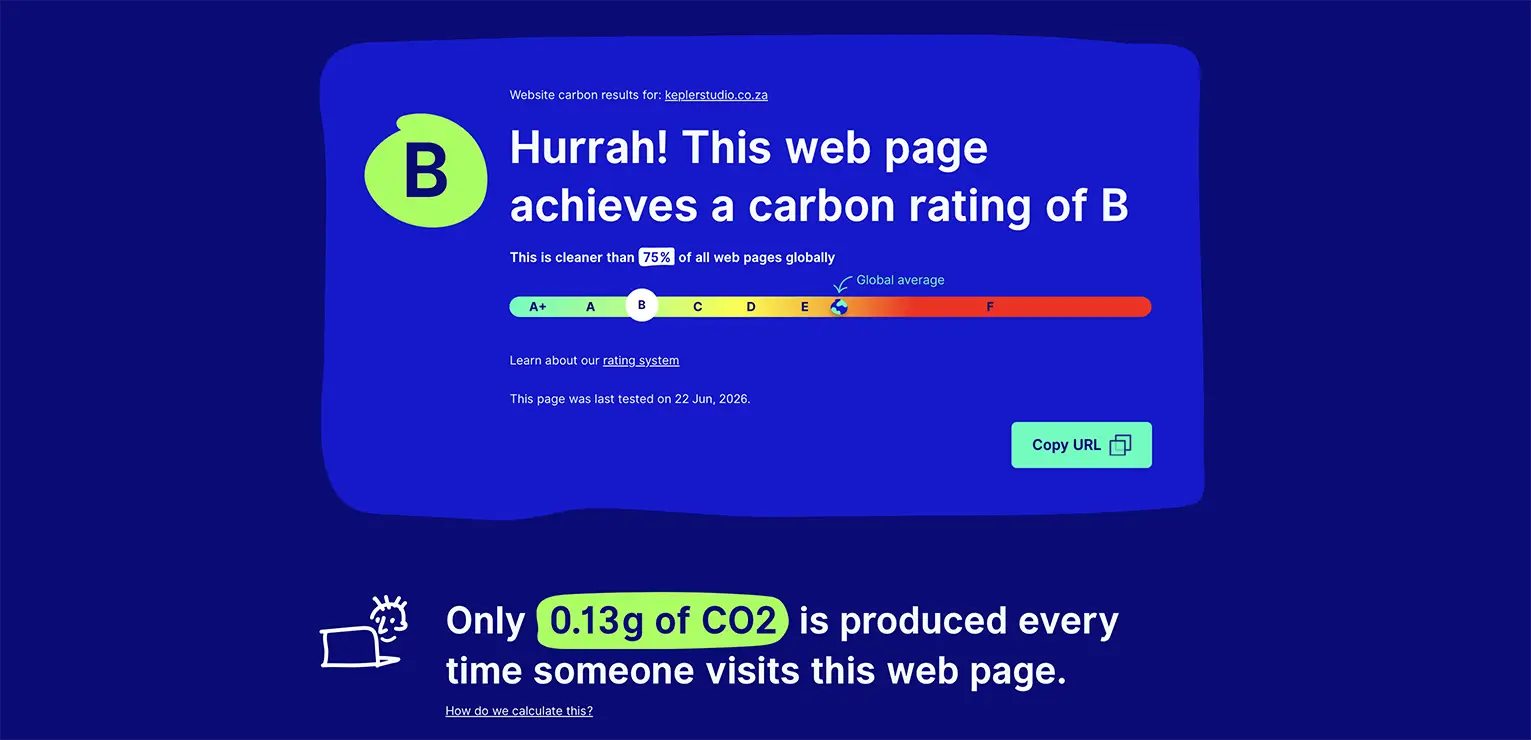
When we added tracking, search visibility tools and structure to help search engines and AI discovery systems understand the site, the page became slightly heavier. Our current landing page rating sits at a B, generating around 0.13g of CO₂ per view and performing cleaner than 75% of websites tested.
It is also important to note that carbon calculators measure individual pages, not entire websites. A lighter landing page does not mean every case study page will perform the same, especially when those pages carry more visual assets.
To make the digital feel more physical, I joined a local tree-planting initiative. The trees are not an offset or a neat transaction. They are a reminder that digital choices still have real-world consequences.
The site is hosted via Framer on AWS infrastructure. While Amazon has matched its electricity use with renewable energy purchases, that is not the same as every data centre running on renewable energy every second of the day. Our next milestone is to explore verified 24-hour green hosting options.
Why Sustainability is Great for Business
This exercise proved that sustainable design is not a creative compromise. In fact, some of the easiest environmental improvements are also the single best things you can do for your user experience:
A lighter campaign page loads significantly faster, directly boosting conversion rates.
Compressed media assets use less of your audience mobile data when they are browsing on the go.
Clean, deliberate content structures help your core brand message land faster.
This logic does not stop at websites. Even on social media platforms, which compress your videos automatically upon upload, the master file size matters. Uploading a massive, unoptimised video forces social media servers to work overtime, expending heavy computing power to transcode your file. True digital sustainability starts in the production phase, by being cleaner and more intentional with how we build assets from day one.
On its own, one optimised page is a drop in the ocean. But scale changes the math. If just 100 brands receiving moderate monthly traffic reduced their landing page footprints significantly, the collective savings would equal tonnes of carbon dioxide emissions every year, the equivalent amount of carbon absorbed by hundreds of mature trees annually.
Behind every click is a physical system. We do not need to stop communicating; we just need to build smarter. Sustainable communication is not about doing less, it is about making a better impact with less waste.
References
Amazon (2024) Amazon Sustainability Report. Available at: https://sustainability.aboutamazon.com/ (Accessed: 10 June 2026).
Andrae, A.S. (2020) 'Hypotheses for primary energy use, electricity consumption, and carbon footprint of global information and communications technology to 2030', Communications, 8(2), pp. 64 to 71.
Freitag, C., Berners Lee, M., Widdicks, K., Knowles, B., Blair, G.S. and Friday, A. (2021) 'The real climate and transformative impact of ICT: A critique of estimates, trends, and regulations', Patterns, 2(9), p. 100340.
Sustainable Web Design (2024) Sustainable Web Design Model: Version 4. Available at: https://sustainablewebdesign.org/ (Accessed: 10 June 2026).
Website Carbon (2026) How does it work? Calculating page view emissions. Available at: https://www.websitecarbon.com/ (Accessed: 10 June 2026).