
Why Information Alone Does Not Change Behaviour
Beyond Awareness
In creative agencies, we love our commercial metrics. Clicks, impressions, shares, sign ups, and conversions tell us if a campaign caught someone’s eye or moved them closer to an action. But as our work shifts towards sustainability, ESG storytelling, and green tech, we have had to ask a different question.
What if the goal is not only to get someone to notice or buy, but to help them make a better choice?
This question led me to recently complete the SDGAcademyX course, Changing Behaviour for Sustainable Development, through edX. The course introduced tools for identifying target behaviours, understanding audience drivers and barriers, and thinking more carefully about which interventions are suitable before jumping to communication.
Around the same time, Rutger Bregman’s work on moral ambition gave me another useful lens: what would it look like to apply professional skill to problems that genuinely matter? For me, that does not mean pretending a creative studio can solve sustainability on its own. It means being more intentional about the kind of work we choose, the partners we learn from, and the rigour we bring before making anything public.
To be transparent, Kepler Studio is not a behavioural science consultancy. Behavioural scientists are the specialists doing the rigorous research, data collection, and field testing needed to understand human bias and behaviour.
Our role is different.
We want to partner with that science and translate complex findings into clear, intuitive visual environments, brand stories, and campaign systems that help purpose-led organisations communicate more effectively.

The Myth of Awareness
Many sustainability campaigns still operate on a simple premise: if people know more, they will do more.
But behaviour is rarely that clean.
Environmental psychology often refers to this disconnect as the value action gap, which is the space between what people care about and how they actually behave. People make decisions when they are tired, distracted, price sensitive, confused, rushed, or operating on habit. So if the real barrier to a sustainable choice is convenience, trust, or friction, a louder message will not solve it.
More awareness is not always the answer. Sometimes the answer is a better understanding of the behaviour itself.
The Risk of Normalising the Problem
Consider a beautifully shot campaign showing the shocking scale of food waste or carbon emissions. The typography is perfect. The photography is striking. The statistic is hard to ignore.
But there is a risk.
When people see that a harmful behaviour is widespread, they may interpret the message as an indicator that everyone else is doing it, so their individual effort does not matter. Behavioural science work on descriptive and injunctive norms shows that messages highlighting how common a negative behaviour is can sometimes unintentionally reinforce the very behaviour they are trying to reduce.
That does not mean we should avoid facts. It means facts need to be framed carefully. A campaign can be visually powerful and still be strategically wrong.
Communication as Choice Architecture
This is where communication and behavioural science become exciting. Before we jump to a campaign, we need to understand the behaviour.
Who needs to do what differently?
When does the decision happen?
What is getting in the way?
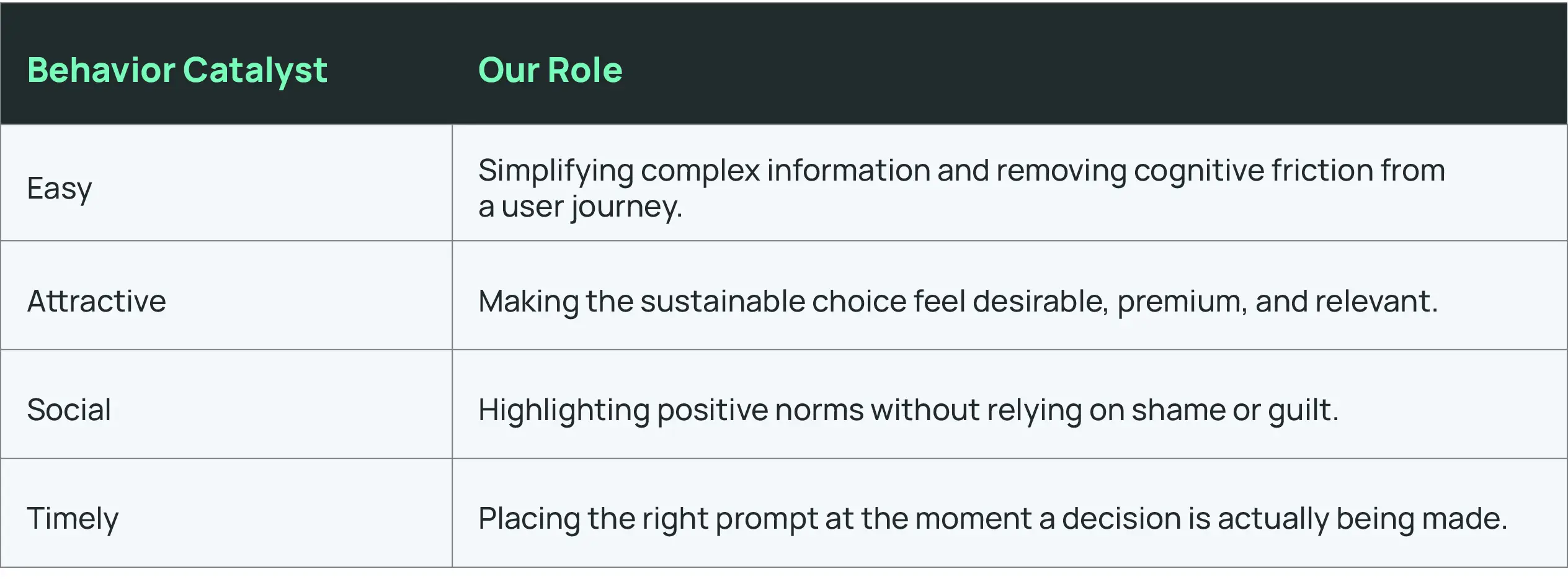
Frameworks like EAST, developed by the Behavioural Insights Team, are useful because they remind us that behaviour is shaped by more than information. To encourage action, the desired behaviour should be Easy, Attractive, Social, and Timely.
For creative work, that might mean:
Easy: Simplifying complex information and removing cognitive friction from a user journey.
Attractive: Making the sustainable choice feel desirable, premium, and relevant.
Social: Highlighting positive norms without relying on shame or guilt.
Timely: Placing the right prompt at the moment a decision is actually being made.
Sometimes the most effective solution is not a massive awareness campaign. It may be a clearer label, a smarter default, a better comparison tool, or a more intuitive prompt at the point of purchase.
From Intention to Action
At Kepler Studio, we help impact driven organisations turn complex ideas into clear brand stories, campaign systems, and communication that people can understand, trust, and act on.
We do not have all the answers, and we are not here to lecture audiences. But we do believe better creative work starts with better questions.
What is the hidden friction point?
Are we trying to change a belief, a behaviour, or a visual environment?
Are we making the right choice easier, or just making the problem louder?
Awareness is a vital starting point, but it is only the beginning. If we want sustainability to move from intention into action, we need to design the steps that follow.
References
SDG Academy / edX. Changing Behaviour for Sustainable Development.
Rutger Bregman. Moral Ambition.
Kollmuss, A. and Agyeman, J. 2002. Mind the Gap: Why do people act environmentally and what are the barriers to pro-environmental behavior?
The Behavioural Insights Team. EAST: Four Simple Ways to Apply Behavioural Insights.